INTIOUS DATA / WORKFORCE
FTE Conversion Table: 20–40 Weekly Hours
Convert 20–40 scheduled weekly hours to FTE against a 40-hour baseline. Explore the comparison chart, download CSV and check the calculation limits.
EXPLORE
See the numbers behind the answer
40-hour full-time baseline
| Scheduled weekly hours | Full-time baseline hours | FTE |
|---|---|---|
| 20 | 40 | 0.5 |
| 22 | 40 | 0.55 |
| 24 | 40 | 0.6 |
| 26 | 40 | 0.65 |
| 28 | 40 | 0.7 |
| 30 | 40 | 0.75 |
| 32 | 40 | 0.8 |
| 34 | 40 | 0.85 |
| 36 | 40 | 0.9 |
| 38 | 40 | 0.95 |
| 40 | 40 | 1.0 |
What does this mean for your planning?
FTE makes schedules comparable, while headcount counts people. Two 20-hour schedules total one scheduled FTE at this baseline, but still represent two people. Use the measure that matches the question.
A different full-time baseline changes every ratio. Thirty hours is 0.75 FTE at 40 hours, but 0.8 FTE at 37.5 hours. This comparison does not determine benefits eligibility or a statutory reporting calculation.
Use your own figures
REPRODUCIBLE, NOT ESTIMATED
Methodology and limitations
Divide scheduled weekly hours by a 40-hour full-time weekly baseline. Inputs run from 20 to 40 in two-hour steps. No absence adjustment is made. This is scheduled capacity, not productive capacity or a legal classification.
Source: Intious original calculations, generated 2026-10-04. Reference period: Defined weekly scenarios. These are defined planning scenarios, not survey findings, observed employer behavior or legal requirements. The CSV contains the complete published input/output table. Display rounding does not change the underlying formulas.
Read our calculation methodology and editorial policy. Found an error? Email hello@intious.com with the row and your calculation.
Common questions
Is 30 hours 0.75 FTE?
Yes, if the full-time comparison baseline is 40 hours: 30 ÷ 40 = 0.75. A different baseline gives a different ratio.
Is FTE the same as headcount?
No. Headcount counts people. FTE adds their hours relative to one defined full-time schedule.
Can this determine benefits eligibility?
No. This is a scheduled-capacity comparison. Benefits and statutory reporting may use different definitions and rules.
Cite this data in your own work
Intious. “FTE Conversion Table: 20–40 Weekly Hours.” Updated 2026-10-04. https://intious.com/data/fte-conversion-table/
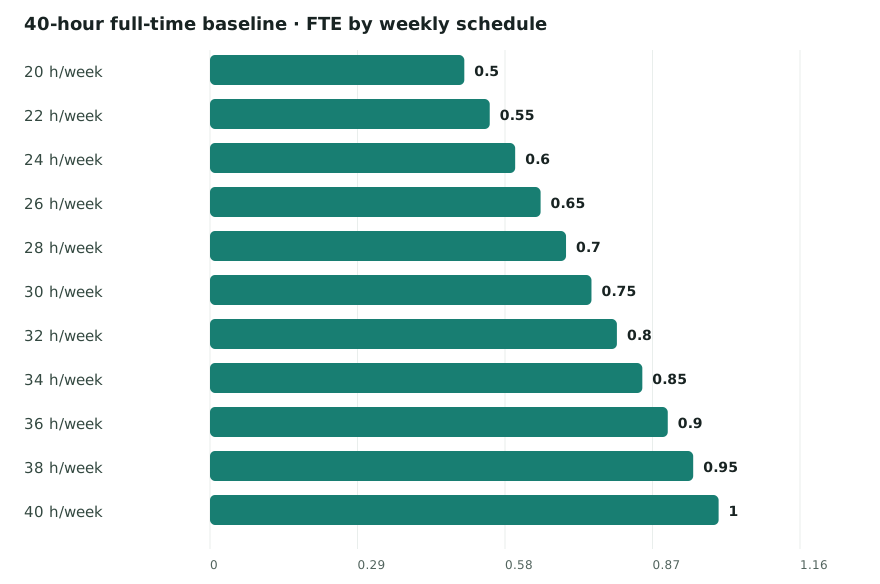
You may reproduce these original tables and charts with attribution to this page. The exported chart shows the first view; the CSV includes every view.
Embed code with source attribution
<figure><img src="https://intious.com/assets/data/fte-conversion-table.svg" alt="FTE Conversion Table: 20–40 Weekly Hours" loading="lazy" style="max-width:100%;height:auto"><figcaption>Source: <a href="https://intious.com/data/fte-conversion-table/">Intious — FTE Conversion Table: 20–40 Weekly Hours</a>. Divide scheduled weekly hours by a 40-hour full-time weekly baseline. Inputs run from 20 to 40 in two-hour steps. No absence adjustment is made. This is scheduled capacity, not productive capacity or a legal classification.</figcaption></figure>