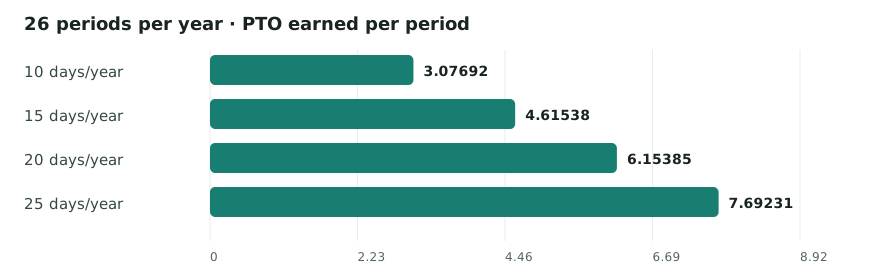
PTO earned per period (hours). Source: Intious calculations; Multiply annual days by eight hours, then divide by 12, 24, 26 or 52 equal accrual periods. Values are shown to six decimal places. Assumes a complete eligible year, no caps, no used leave and no changes in rate.
PTO Accrual per Pay Period: 10–25 Days — 26 periods per year
Annual days
Annual hours at 8/day
Periods per year
Hours per period
10
80
26
3.076923
15
120
26
4.615385
20
160
26
6.153846
25
200
26
7.692308
24 periods per year
PTO earned per period (hours). Source: Intious calculations; Multiply annual days by eight hours, then divide by 12, 24, 26 or 52 equal accrual periods. Values are shown to six decimal places. Assumes a complete eligible year, no caps, no used leave and no changes in rate.
PTO Accrual per Pay Period: 10–25 Days — 24 periods per year
Annual days
Annual hours at 8/day
Periods per year
Hours per period
10
80
24
3.333333
15
120
24
5.0
20
160
24
6.666667
25
200
24
8.333333
12 periods per year
PTO earned per period (hours). Source: Intious calculations; Multiply annual days by eight hours, then divide by 12, 24, 26 or 52 equal accrual periods. Values are shown to six decimal places. Assumes a complete eligible year, no caps, no used leave and no changes in rate.
PTO Accrual per Pay Period: 10–25 Days — 12 periods per year
Annual days
Annual hours at 8/day
Periods per year
Hours per period
10
80
12
6.666667
15
120
12
10.0
20
160
12
13.333333
25
200
12
16.666667
52 periods per year
PTO earned per period (hours). Source: Intious calculations; Multiply annual days by eight hours, then divide by 12, 24, 26 or 52 equal accrual periods. Values are shown to six decimal places. Assumes a complete eligible year, no caps, no used leave and no changes in rate.
PTO Accrual per Pay Period: 10–25 Days — 52 periods per year
Annual days
Annual hours at 8/day
Periods per year
Hours per period
10
80
52
1.538462
15
120
52
2.307692
20
160
52
3.076923
25
200
52
3.846154
What does this mean for your planning?
Choose the annual allowance and the number of accrual events in the policy. Payroll frequency and accrual frequency can differ. A monthly accrual policy does not become biweekly simply because wages arrive every two weeks.
Retain precision in the running balance and apply the employer’s specified rounding rule. Rounding every period can create a small annual difference. Front-loaded leave, waiting periods, carryover and caps require separate treatment.
Multiply annual days by eight hours, then divide by 12, 24, 26 or 52 equal accrual periods. Values are shown to six decimal places. Assumes a complete eligible year, no caps, no used leave and no changes in rate.
Source: Intious original calculations, generated 2026-10-04. Reference period: Defined annual scenarios. These are defined planning scenarios, not survey findings, observed employer behavior or legal requirements. The CSV contains the complete published input/output table. Display rounding does not change the underlying formulas.
Divide the annual hour allowance by the number of accrual events in your policy. For 120 hours and 26 equal periods, the rate is approximately 4.615385 hours.
Does a 27-payday year require dividing by 27?
Only if the policy allocates a fixed annual allowance across 27 accrual events. Some policies use a fixed rate or a different accrual calendar. Check the stated rule.
Are these typical employer allowances?
No. The 10, 15, 20 and 25-day inputs are illustrative scenarios, not measured averages or recommendations.
You may reproduce these original tables and charts with attribution to this page. The exported chart shows the first view; the CSV includes every view.
Embed code with source attribution
<figure><img src="https://intious.com/assets/data/pto-accrual-benchmarks.svg" alt="PTO Accrual per Pay Period: 10–25 Days" loading="lazy" style="max-width:100%;height:auto"><figcaption>Source: <a href="https://intious.com/data/pto-accrual-benchmarks/">Intious — PTO Accrual per Pay Period: 10–25 Days</a>. Multiply annual days by eight hours, then divide by 12, 24, 26 or 52 equal accrual periods. Values are shown to six decimal places. Assumes a complete eligible year, no caps, no used leave and no changes in rate.</figcaption></figure>
Changelog · 2026-10-04: First publication with formulas, full tables and downloadable data.